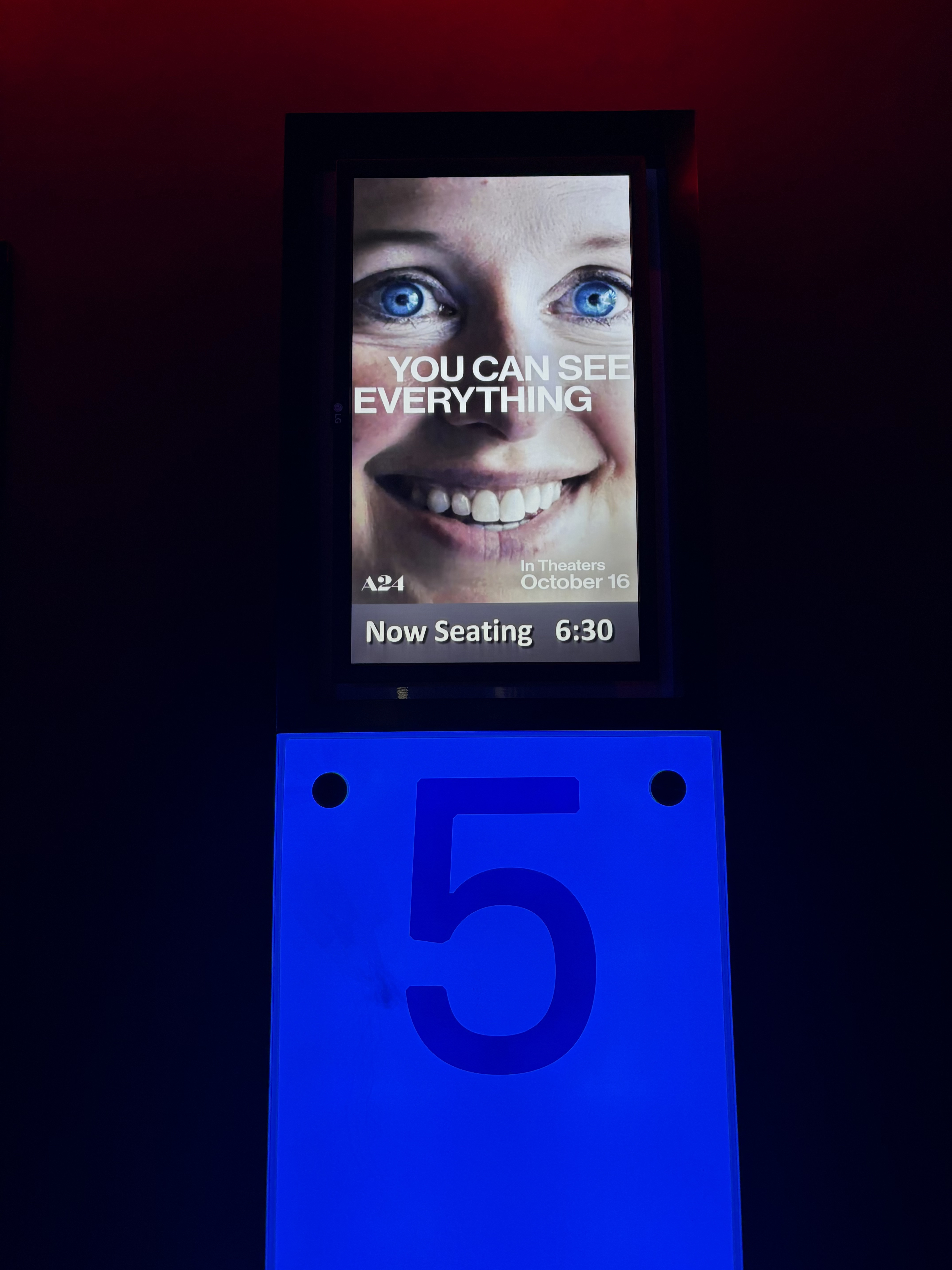
I can see you! (Photo: Alexandria Deters)
You Can See Everything is the movie that the Internet can’t stop talking about. And apparently, neither can we! At the same time as Donna Oblongata submitted her much more considered article, we were independently debating: Is Elizabeth Holmes the most manipulative person who has ever lived? Is she a wide-eyed ingenue? A traumatized survivor turned people-pleaser? An icon for defrauding wacks like Robert Kraft and Rupert Murdoch? So your blood test was wrong, who cares! What the fuck is up with Billy Evans? Is Nathan Fielder really that autistic, or does he speak with more inflection during his off-hours? After sitting nose to the screen in the second row, Emily Colucci and Alexandria Deters had a chat about their reactions (Do we even have to preface that there are going to be lotsa spoilers?):
Alexandria: We have to start by noting that a week in advance, our showing was almost sold out for 6:30 pm on a Thursday, which forced us to sit in the second row! My neck was a bit sore after watching at such an odd angle for so long! Despite the strain, I will say it added to the experience of the absurdity of the film.
Emily: I was worried that sitting so close was going to make me dizzy. It’s happened before when, after I leave the theater, it takes a while for my vision to stop swimming. But I think we were actually too close to trigger vertigo. But it did trigger Vertigo, given Nathan’s equally manic tapping of an actress to play the object of his obsessive fascination, just like Jimmy Stewart’s Scottie. Not to get on a tangent too early, but there are fascinating parallels here with Kim Novak’s unknowable blonde!
But to return to the forced seat choice, grudgingly, I have to admit that it was actually appropriate given all the Cassavetes Opening Night-style closeups of Nathan Fielder, Elizabeth Holmes, and her beau, Billy Evans. Much of the film already took on the face-to-face feel of an interrogation, and our seats really heightened that! We could stare directly into Elizabeth Holmes’s empty eyes as she claimed to have never done anything wrong. We could gaze into Billy Evans’s psycho abyss as he monomaniacally took business calls for some other (likely) scam startup. But even more, I spent a lot of time inspecting everyone’s teeth, from Elizabeth Holmes’s unique bunny teeth to Nathan’s stained front tooth. Yeah, we were too fucking close!
That being said, there were things I missed that I have no excuse for overlooking, namely just how geeked-out on coke Billy Evans clearly was, particularly in the second half of the film. Someone on X posted the clip of his Charlie Kirk-inspired freakout, and his eyes were popping out of his head. He was completely zooted! I was so focused on the wacko shit he was saying about having vengeance in his heart and attributing it to his sociopathy, in conjunction with or in comparison to Elizabeth Holmes’ wide-eyed vacancy. I was in psych mode, not drug mode.
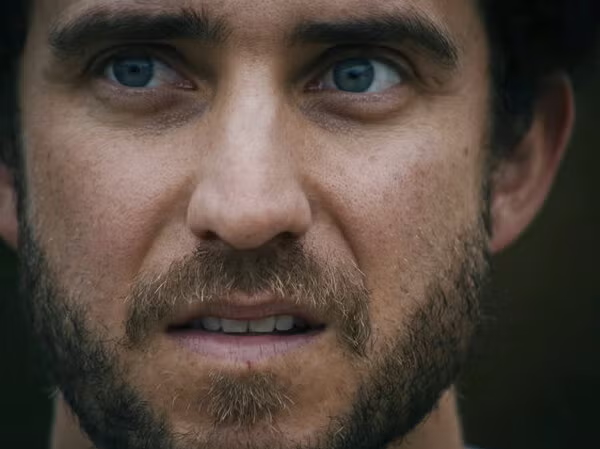
Billy has vengeance in his heart (Courtesy A24)
Alexandria: One of the things that really set the tone of the raw, awkward tension early on was that excruciatingly long shower scene where we get an eyeful of Billy Evans’s Johnson. Why do you think they kept that in? What was a power move?
Emily: While I had hoped it would be Nathan hanging dong, that dangling shocker still made me laugh. Definitely a power move. I was actually more disturbed that he was brushing his teeth in the shower. But this goes back to my previous point, so much of Billy’s insanity can be explained by a serious cocaine addiction! “I’m going to show my schlong on the big screen” seems like an intoxicated idea.
But beyond Billy’s manhood, You Can See Everything was advertised as a film about Elizabeth Holmes, but it’s just as much about Billy Evans. It could be very easy to paint Billy as the villain of the film and not think about it much further. He’s manipulative. He’s narcissistic. He’s domineering. He’s controlling. He doesn’t let Elizabeth Holmes beat her own eggs (though, in his defense, she was kind of stirring them slowly!). He wants to make a fake Elizabeth Holmes for their new scam business. He can’t stop making douchey posts on X in her name. While he is clearly a horrible person, I also don’t buy Elizabeth as some lovesick victim who just happened to defraud people with Theranos in an earlier romance and is now getting drawn into the web of another startup fraud.
Are Elizabeth and Billy made for each other? Two grifters in love! I did like the tag team of gaslighting those two would attempt on Nathan, when Billy, especially, would jump in to either affirm what she said or assert that her “brain works differently.”

Hmmm…who do you think posted this one?
Alexandria: They are in a toxic, manipulative relationship, but I think it’s mutually toxic and beneficial (but maybe not beneficial for mankind). I think they manipulate and use each other. Even the way they described meeting each other. Billy said he didn’t recognize Elizabeth because she was wearing a hat the first time? Like, come on, bro. That is such a lazy lie, and also such a weird thing not to admit. Are you trying to say you were so enamored with her and her fantastic conversation skills in the first hour that her true identity wasn’t obvious? That feels extremely unlikely, because she speaks in a very recognizable tone of voice (as has often been mocked) and the way she looks at people when speaking is quite…distinct, to say the least. He was infatuated and clearly still is with her–and his projects now have her backing. While we may think she’d be a negative addition to any company, she’s still a big name.
Elizabeth’s toxicity comes off as more corrosive. She is more aware than she lets on and uses that with Billy and with Nathan, as seen in her confusion at Nathan showing her the Abbott and Costello “Who’s on First” skit. Her lack of understanding of who (“Who”) was on first and why it was funny literally made my jaw drop. Nathan explained it so simply, and yet it somehow didn’t click? She’s not dumb. I get that you can be a little bit socially inept because you’re so smart. I know people like that, but she was acting like she had no idea why it was funny. I kept asking: Is this woman really that socially unaware? That culturally ignorant? Or is she truly the most masterful and manipulative woman I have ever witnessed? Did she really not get it, or was she setting herself up to validate why she said she never did anything wrong because, in her mind, she was never untruthful to investors?
Emily: Part of me believes she was zoned out in postpartum land, and Nathan was overanalyzing because he was dorking out on a bit of comedy history. Are you really going to pay that close attention to an old-as-fuck comedy bit when you just had a baby and are going to prison? I can imagine zoning out too because that feels obnoxious.
But the central questions of the film are: Are we being manipulated? If so (clearly the answer is yes), who is manipulating us? My theory is they ALL are manipulating us, and I include Nathan and Lance Oppenheim in this. The truth is slippery throughout the whole film, if any of it is even true! There were a few other interactions with Nathan and Liz that I was very taken by. One is the scene in which he asked her if she’s ever lied, which she denies entirely. This, to me, was the instant sign of a pathological liar. Nobody has NEVER lied! Have you ever known a pathological liar, though? They love lying about inconsequential stuff like that.

Alexandria: I’m not sure if Elizabeth even realizes she is lying anymore. She reminds me of Jim Jones. She’s become used to her version of the truth for so long that even she started to believe it fully. Deep down, she knows she was wrong and lied. I don’t think she’s ever going to let herself accept that because that would mean coming to terms with all the fucked-up shit that she did. And if she continues to play this “I was just misunderstood” card, then she doesn’t have to carry that kind of guilt with her everywhere. She can probably pass a lie detector test because she believes her own bullshit.
Her comeback with this new product with the lasers is another fantastical medical idea. From how it was explained, I don’t think it is actually that far-fetched. But she and Billy do not have any type of medical degrees or expertise with lasers. She’s just saying things. She hasn’t learned her lesson. It’s like that Zuckerberg quote: “Move fast and break things.” That’s all well and good (well, clearly not, because look at the state of society with social media), but…with medical products? You are setting up to create something that could literally kill people. Their comeback is just an idea that they hope will lead to something groundbreaking, but it is more likely to result in people’s deaths.
And Billy is a critical part of this redemption campaign when she leaves prison. Her attempt at a comeback is very strategic, down to the fact that she created, I guess, a completely 3D or hologram version of herself to speak to the kids. The way she says things like giving Billy power of attorney is strategic, too. How much of that is him being controlling and nefarious, and how much is she actually allowing it so when things don’t go her way she can say, “I didn’t do that. I was in prison; that was all Billy.” It’s all very strategic.

Creating a new Liz Holmes in “You Can See Everything” (Courtesy of A24)
Emily: “Move fast and break things”! I’m glad you brought that up because, while there are so many angles contained within the film, I was interested in what it shows about the malignant personalities at the center of Silicon Valley’s techno-optimism (for wonderful insight into that ideology, wait a few months for David Karpf’s Vaporware, Inc). Billy has more of the typical coked-up, wheeling-and-dealing startup founder gone mad energy, while Elizabeth, who is clearly performing on some level, takes on an almost mystical role. From that famous picture of her with that tiny blood vial, Elizabeth Holmes was the quintessential Silicon Valley ingenious dropout scientist/capitalist in the Steve Jobs turtleneck. Rather than showing the “real” Liz Holmes, You Can See Everything gives us a bunch of funhouse mirror reflections, which perhaps is what it’s like getting close to these people. I wouldn’t know. And I have no intention of finding out!
I was particularly haunted by Nathan’s struggle to parse Liz’s claim that the Theranos machine COULD do all those tests, but it wouldn’t because the chemistry was not available yet. Technically, it could, but it can’t. Those unsubstantiated predictions of what it could do made me think about all the boastful claims coming from the tech oligarchs. Superintelligence abundance! AI cures for cancer and climate change! Robots! So many robots. Colonizing Mars! Uploading consciousness! Living forever! Will all these ideas just end up defunct in a rental home garage like the Theranos machine? Or squirreled away in Jeff Bezos’s mountain like the 10,000-year Clock of the Long Now, a futurist project I’m completely obsessed with? Of all the tech founders, Elizabeth reminds me the most of Elon. People have crashed and burned alive in his Teslas, and somehow he’s still going strong. There was an overt reference to Elon in You Can See Everything before Billy shut it down instantly. He probably wanted Elon’s funds for their newest startup.
With all these claims of a better and brighter future that’s just within reach, Elizabeth is not a uniquely heinous character, and hey, she may even be a hero considering she defrauded some of the worst people in the country, like Larry Ellison! What’s so bad about that?!
Alexandria: The problem is that type of ‘tech’ mentality is being used in a field that really shouldn’t be: medical technology. And we’re seeing it in the weird way they approach everything. It felt so bizarre that in their home, the old Theranos boxes were everywhere. It’s not a trophy; it’s a relic of failure and an ill-conceived dream. Maybe keep it in a box under your bed or in your basement.
Maybe it’s because of my own experience living in San Francisco during the height of the tech boom that I am so critical of it. It’s also why I enjoyed the film so much. It shows that a woman, not a man, is the innovator, and that, unlike other tech powerhouses, she actually had to deal with the consequences of her failures. It does make me think that it is probably BECAUSE she is a woman that she actually got such a long sentence. But, either way, we now know that Silicon Valley has caused so much destruction, and watching this film was like watching the clean-up of a car crash. I can’t look away; the evidence is everywhere, and it makes you feel a little sick.

Emily: I saw You Can See Everything a few weeks after seeing co-director Lance Oppenheim’s Primetime on Chris Hansen, which, in part, uses To Catch a Predator as an allegory for the United States’ national crackup post-9/11 in which we embraced surveillance, militaristic force, rooting out evil doers, and “You’re either with us, or you’re with the terrorists” binary thinking. While I think we are still very much in that post-9/11 Primetime world, You Can See Everything is more about our current culture in which everything is a grift, everyone’s motives are suspect, and everything is quite possibly fake. The twist halfway-ish through, when the documentary format becomes half-fictionalized with the appearance of my Mother Ann Lee, Amy Seyfried, is evidence of that (Even Amanda gets called out for her exploitation of Elizabeth’s story, though you can argue whether performing as a real person is exploitation or not). Everyone in the movie is an unreliable narrator. Which somehow tracks with our extractive casino economy of influencers and predictive markets that is imbued with a general sense of unreality. Hell, we can overlook this because it’s become so ho-hum after a decade, but Trump is the president. Talk about unreality!
Alexandria: Elizabeth is the example of that cultural pinnacle we used to idealize being a farce. She shows that the idea of the tech genius, the entrepreneur with no strings attached, where an idea is above all else, is unsustainable. That approach cannot work for everybody, and not everybody should be listened to, no matter how captivating and creepy their eyes are. Not everybody’s ideas should be made into reality, financed, or given complete free rein, because they can end up destroying lives and giving false hope. If anything, it shows us that people like her, without real guardrails (and impactful consequences), will never stop. And what does that say for the present and future world?
We’re actually seeing the consequences of her actions. We’re not seeing this sugarcoated, TikTok version of life. She’s in jail. She has to ask for snacks in prison. That was one of my favorite scenes: Elizabeth (well…sort of Elizabeth) asking for jerky from Nathan after he offered because she’s no longer in control of her life. No matter how much she wants to manipulate, she cannot manipulate in the same way she did on the outside.
Nathan’s character in the documentary is very interesting, too. It’s so much more personal, even though Nathan’s personality is very awkward. It is honest, and it feels like he’s coming to terms with what he is witnessing himself, which I feel like we, as a society, are doing right now with the ramifications of the way we’ve let tech run wild in our society, in this country, and in the world.
Emily: Since we’re talking about her prison time, I was disappointed we didn’t get a glimpse of Ghislaine Maxwell, who was moved to that same prison (though Todd Blanche may have moved her there after they shot the film), or her puppy. I’ll be honest, despite picking through Liz’s personality, I’m not all that compelled by the Theranos scam, certainly not as much as Ghislaine. How about a sequel, You Can See Epstein?! Back to Nathan, I’m actually not sure he is honest! There are a few moments in which he also lies or potentially whitewashes scenes to show us what he wants. Of course, the film makes a larger point about the unknowability of anyone. I don’t want to ruin the ending, but I keep mulling over the final scene, which puts the entire veracity of the film into question. But I feel like our conversation has become too serious, so I want to end on this note: What the fuck was with all of Billy Evans’s lizards?
Alexandria: In that last scene, I did wonder if she was thinking: If I just keep swimming into international waters, could anyone stop me? Ok, the lizards: In my opinion, Billy is one of those creepy men obsessed with exotic animals, like Joe Exotic in Tiger King or the new Monsters of God series on HBO. The minute Elizabeth was gone, he started getting more and more of these creatures. Do they make him feel more masculine? I also can’t help but think the way they wander around the house is not the safest for the lizards or for the little kids who live there. Don’t kids put everything in their mouths?!
Emily: Of all the on-screen animals, I certainly preferred the gassy donkey!