
Flyer for the Elizabeth Holmes look-alike contest on Houston Street (Photo: Emily Colucci)
In 2022, when Nathan Fielder’s The Rehearsal debuted on HBO, OpenAI had not yet publicly released ChatGPT. Elon Musk had not yet embedded himself in the highest levels of the federal government so as to dismantle it. AI as an industry had not yet upended job markets, our collective and individual mental health, or the entire global economy. It had not yet drained our water supply and pillaged our electrical grid—even if behind closed doors, the titans of that industry (Altman, Amodei, Bezos, Musk, Gates and late-to-the-party Zuckerberg) were meticulously/haphazardly setting those plans in motion.
During that simpler time, I tuned in for a couple episodes of The Rehearsal after friends gushingly recommended it. Watching the show with my partner, our faces both contorted with horror. But if you don’t like a show, gushing recommender friends will always insist that you picked a bad episode, so we watched a few before mutually agreeing we could stomach no more. Already, it felt like a mark upon our souls. Like we’d been subjects in a type of Milgram experiment, the scientists watching us through the screen, ready to note down how long it took for us to stand up and reject what felt like a very slippery brand of cruelty.
Gushing recommender friends couldn’t believe it. How could you not think it’s funny? He’s doing something no one else is doing! Except, no. As far as I could tell, Fielder was doing exactly what the wealthiest and most powerful men in our country were doing: being handed abundant resources that he then used to manipulate others’ perceptions of reality—people with dreams and aspirations far humbler than his own—for his own enrichment (and as a byproduct, our entertainment). But where a tech overlord does this to all of us, everywhere, Fielder’s project is much more Truman Show.
Now, is it maybe hyperbolic to compare a short-lived HBO show to Zuck’s use of Facebook to transform how literally billions of people perceive reality? Sure. But somethingsomething art imitates life, somethingsomething life imitates art. And anyway, do we actually want to throw our cultural lot in with a man who seems so super horny for manufacturing living dioramas where he gets to play Herr Puppet Meister in a microcosm of our current reality-bending dystopia? The point is, the show just tripped my personal killjoy wire. I couldn’t get past the parallel. Cue the old “How many feminists does it take to change a lightbulb?” joke.
But also, cue 2026, where disinformation is so widespread that now it’s the water we’re all swimming in. The blurring/erasure/silencing/siloing of truth is full on. And thanks to the box office smash of You Can See Everything, we’ve all gotten to see just how closely Fielder’s oeuvre has paralleled the trajectories of our feudal tech lords these past few years. (Would love to see a side-by-side graph of their respective income trajectories, but anyway—.)
Suddenly, everyone is talking about this movie. I had to go into a kind of sequestration in order to preserve myself from spoilers for the week between when it opened and when I was able to see it. (Sure, I think Fielder is a sociopath, but I’m not going to miss a cultural moment!) Finally, after watching (which, for the record, I loved the film; I had a great time), I binge-read every review and think piece that crossed my path, hoping to find the critical analysis that can put out the fire in my mind that this film has caused. But as far as I can tell, besides a few hot takes on Reddit, every single bit of writing comes down to the same milquetoast thesis: What even is reality, amiright?
Meanwhile: Back in September, the nation became out-of-its-mind obsessed with the case of “Jane Doe”, the former Cornell student who two years ago accused seven fraternity members of gang rape. The case went practically nowhere at the time, but swung into the national conversation a few weeks ago, when Doe filed a civil lawsuit, the Cornell student newspaper took up the cause, and social media went fucking berserk, forcing the story to the top of the fold in everything from The New York Times to The Atlantic to whatever news station was playing in the Holiday Inn Express breakfast room in Quispamsis, New Brunswick at the time.
Critically, the news blitz around the case revealed that the DA in the Cornell case declined to press charges two years ago because (he says) the 6-page summary of Doe’s statement to police did not actually say she’d been raped. But in her actual, much longer statement that she gave to the police (not the summary), she said: “I can say with 100% certainty that I was raped.”

Text messages from the Cornell case (from The New York Times‘ trove of messages)
Much like You Can See Everything, which debuted in theaters a few weeks later, everyone has something to say about the Cornell case. My social media feed fills with everything from calls for criminal charges against every man in the 50-member Snapchat group to intricate diagrams illustrating the spectrum of male rapey-ness. There’s even thou-doth-protest-too-much-style crusades by definitely-not-rapey men who vow to basically Nancy Drew this whole case on their own, via this new website they made, and btw, here’s the Venmo link so their 750k followers can support their independent research. All while Jane Doe is being doxxed, swatted, and, we must assume, generally terrorized by having an entire nation deafeningly debating whether or not what she experienced “counts” as rape. In short, the multifaceted male incompetence or willful negligence that bungled the case led to a two-year battle for justice that culminated in the civil lawsuit, and the ensuing trial of Jane Doe in the court of public opinion.
But at least the entire nation was seemingly Ready For The Conversation. But it wasn’t #MeToo. We’re far too post-truth for that. Like, if a major hurdle to justice for sexual assault survivors has historically been the he-said-she-said of it all (within a system run by the hes, obvs), the Cornell case brought us a showcase example of how that conundrum now refracts in a billion different directions when viewed through the shattered lens that the men who created this post-truth situation have left us with.
Sexual assault on college campuses is not new. Drugs and alcohol have contributed to shitty and legally ambiguous sexual encounters since forever. Fraternities are so closely associated with rape that the argument in their defense is generally that young women should be careful inside those walls—not that the endless stories of rape simply aren’t true. And even within feminist circles, fingers can still be found wagging about making good choices. But here in our post-truth reality, we’re in a much more compromised position from which to try to make sense of any of this. What even is reality, amiright?!

Text messages from the Cornell case (also from The New York Times)
Before the halfway point in You Can See Everything, Fielder is talking to Elizabeth Holmes’ father, asking when he thinks things took a turn in her life. Pops replies (very clearly, very bluntly) that there were two moments. The first was “when she raped.” Everyone in the movie theater gasps, and the film moves on, never addressing it further. (Yes, Billy hurries them into the other room for family time, but the choice to never revisit the topic in the film is the filmmakers’.)
When Elizabeth Holmes was a 19-year-old student at Stanford University (often called “the Cornell of the West”), she reported being raped at a frat house. She called the cops that very night. Holmes later brought the assault up during her trial, crying on the stand as she described how her response to the trauma had been to throw herself into her work with Theranos (which she started at 19—a year younger than Doe was when she reported being assaulted). She then went on to recount being repeatedly abused and raped by her much older business and romantic partner at the time, Sunny Balwani (who is barely mentioned in the film).
So imagine my surprise when, back on my social media feed, people who a month ago effortlessly clicked share and repost buttons to help focus the spotlight on the Cornell case are now posting goofy memes and videos mocking Holmes’ eerily wide eyes and the sexual tension between her and Fielder that the filmmakers have dialed up to eleven. Etsy is full of shirts and mugs mocking Holmes’ line, “Why would I deceive you?” Super clever people were the infamous bowl of eggs for Halloween.
It’s all left me pretty freaking sad about the state of things, about the collective acceptance that, whatever her level of culpability, Holmes is a worthy target for our national derision. How was all of social media ready to burn the system down last month, but now we’re all just meme-ifying Holmes’ wide blue eyes? How is everyone talking about this film while managing to say nothing? How on Earth is the dominant critical narrative that Fielder is yet another rube whom Holmes has ensorcelled? Like, when it comes to the Cornell case, we’re all here for the micron-level dissections keeping the “was it legitimately rape” ball in the air, but when we’re handed an unblinking look at Holmes as a young woman whose accusations of rape were pretty cut and dry, our response is a Simpsons-style “BO-ring!”
Remember the scene when Fielder and Seyfried are watching footage of Fielder talking to Holmes, and they’re talking about how much they feel compelled to believe her? How in that moment, in their guts, they kind of trust her? Throughout the film, I thought for sure we’d all be leaving the theaters to find street vendors hawking “Free Liz!” shirts on every corner. Didn’t that have to be the point of Fielder’s creepily sympathetic portrait? No? Am I the rube? Weeks after its debut, the general consensus, no matter how much the reviews insist it’s all about whatevenisreality, is that Holmes must be “the most manipulative person who ever lived.”
I’m not a forensic expert, and maybe this is why, but Occam’s razor seems appropriate here. Like, if (and it’s a big if) we are still able to use our critical faculties, synthesize information, and believe our own eyes (and guts), the idea that Elizabeth Holmes is the “most manipulative person who ever lived” seems somewhere between counterintuitive and insane. Don’t we know anything about trauma responses and what they do to people’s brains and motives and actions? Didn’t we all live through the Kavanaugh confirmation hearings? Like, I know Fielder isn’t interested in making that kind of movie, and that’s fine, but maybe we, the public, should at least be smart enough to go: Wait a second, Nathan. You can’t just bring up rape as a defining moment in an imprisoned woman’s life and then let it go without further discussion. Oh, hold a minute. Someone’s asking me how many feminists it takes to change a lightbulb.

Contestants in the Elizabeth Holmes look-alike contest in Washington Square Park
But seriously, wouldn’t “the most manipulative person to ever live” have actually pulled off the con? Wouldn’t someone with that qualification not be repeatedly falling into what appear to be controlling and abusive relationships (including her relationship with Fielder)? Don’t we have ample examples of people who are in the running for that title, and who aren’t in fucking prison?
But she was guilty! She committed fraud! She stole people’s money!
Let’s back this truth trolley up a sec.
This year (2026), Elon Musk was found guilty of misleading investors to the tune of $2.1 billion—pocket change that he has been forced to pay back to those investors, while serving zero time in prison. And meanwhile, his SpaceX company has had the stock market change its rules in order to include the company in common 401Ks and IRAs. In other words, nurses, librarians, teachers, &c., squirreling away modest amounts of income toward their retirement are now railroaded into unwittingly investing in a company that has never turned a profit or successfully accomplished its stated goal (literally colonizing Mars—check their website). Musk also spent a decade declaring that Teslas could operate fully autonomously, which they provenly could not—a lie that has since been litigated and that has actually resulted in human fatalities (no jail time, ofc). At the time of writing, Anthropic’s looming IPO is a thinly veiled gambit by which the company can claw back the billions of dollars they’ve burned through while failing to produce the technology they say is just on the other side of that hill. They need the IPO money to mollify their initial venture capitalist investors because, like SpaceX, they’ve never actually turned anything close to a profit, nor demonstrated a viable, profitable use-case for the technology they’re currently destroying the Earth to build. Meanwhile, various agents and bots have been publicly released with the promise of providing meaningful connection, mental health support, and medical advice. Need I cite the endless stream of cases that demonstrate their failure to do these things, sometimes fatally?
But in what’s possibly the case most analogous to Theranos, Waymo, which bills itself as a fully driverless car, employs people in the Philippines to supervise the vehicles’ movements and, when necessary, operate them remotely like a video game. It’s not fully a Mechanical Turk, but it’s not not one. In other words, because their technology is just shy of being able to do what they say it does, Waymo has outsourced the stuff they cannot do. When Theranos’ devices failed to deliver accurate test results, the company made like Waymo and outsourced the stuff they couldn’t do—which turned out to be basically everything except the sales part. Very bad. But it’s not like they were the first or the last.
But most crucially, Theranos was never a publicly traded company. In other words, Elizabeth Holmes, no matter how sinister you believe her to be, never asked a regular old ape on RobinHood to invest in her company. Every dime that Theranos got from investors came from venture capitalists: people with massive amounts of disposable income, who know they are gambling when investing in a new technology or company—and they are responsible for doing their own due diligence. These aren’t people like you and me. Unless, of course, you are Henry Kissinger, Rupert Murdoch, Larry Ellison, The Walton family, The DeVos family, or any of Theranos’ other primary backers. Please, show me where to donate to the GoFundMe.
With Holmes as the mold-breaking face of Theranos, it seems these investors were ready to line up to “believe women.” Much easier to do when they’re promising you a killer ROI than when they’re calling all of college Greek life into question. These investors handed over truckloads of cash to a woman not old enough to legally drink when she started her company. A young woman who was very likely as vulnerable and unsure about her place in the world of men as Doe was the night she made her way to the Chi Phi frat house on an Ivy League campus.
Today, both Holmes and Doe have had their reputations exploded and teased apart like lab specimens—the magnifying and refracting lenses in each case so powerful that it’s hard to imagine either woman ever being able to fully retrieve control over her own image in the public imagination.
And so, I’ve been thinking about the online movement that started when the doxxers came for Jane Doe. Immediately, people (women) on Reddit and other less-bad places on the internet barraged the web with posts saying things like, “Sherry Valance is Jane Doe” and “Petra Parker is Jane Doe”. Of course, Sherry Valance and Petra Parker are fictional characters. The idea was to flood the algorithms and LLMs with misinformation and misdirection, thereby burying any search results that would reveal Doe’s actual identity. The strategy revealed an intuitive understanding by these defenders of the powerless of how misdirection works. Look anywhere but there. And yet, when it comes to Holmes, we are here for three hours with nothing but a 250mm zoom lens.
But the cover-up! Walgreens had a contract! They were deceiving major companies in the health sector! People could die! I know. But sometimes, you just gotta be willing to humble yourself like the late prophet Jimmy Buffett: “Some people claim that there’s a woman to blame, but I know…it’s my own damn fault.”
Theranos’ crimes were all a decade-ish ago, and it does seem that the rules have changed in the interim. Remember that part of the film when that guy in the room (who was he, again??) starts talking to Nathan about how all entrepreneurs fib a little along the way to sell an idea, before Billy shuts the conversation down? It’s a real “just saying what we’re all thinking” moment. But then you’re out in the world of the internet, and you see a cheeky hat for sale that says, “God forbid a girl lie a little to her investors,” and it’s like, okay, so maybe that wasn’t what we’re all thinking? Maybe it’s just me? Maybe the “Free Liz!” shirts I had printed aren’t going to be big holiday sellers after all?

Contestant in the Elizabeth Holmes look-alike contest in Washington Square Park
But here’s what I really wanna talk about. The main scene rattling around in my brain as I continue to fumble with this Rubik’s Cube is from a different piece of cinema: Patty Jenkins’ Monster. In the 2003 film, Charlize Theron’s character, the real-life serial killer Aileen Wuornos, is convicted of murdering multiple men and handed the death sentence. After sentencing, while being escorted out of the courtroom, Theron (as Wuornos) screams: “Thank you, judge. And may you rot in hell! Sending a raped woman to death!” She turns to the jury and the larger courtroom: “And you all… you’re a bunch of scum, that’s what you are!” It’s a cinematic gut punch that has stayed with many of the people who watched it, including me. Indeed, it won Theron an Oscar. And it’s a retelling that’s remarkably close to what Wuornos actually said on her final day in court. It doesn’t just ring true—it is true.
In real life, in her final taped interview, the day before her execution, Wuornos made another statement. She said (among other things), “You sabotaged my ass! Society, and the cops, and the system! A raped woman got executed, and was used for books and movies and shit! Thanks a lot, society, for railroading my ass.” Monster came out in 2003—a time when Facebook did not yet exist, Elon Musk was someone most people had never heard of, and Sam Altman was still in college, having never started a company. Apple (with Steve Jobs at the helm) had just retired its ubiquitous ad campaign entreating us all to “Think different.” And it would be several years until Jobs unleashed upon the world the iPhone, paving the way for everything from the startup culture that made Theranos possible, to the algorithmic siloing of truths to Chi Phi’s Snapchat group. I guess the ad campaign worked!
Monster debuted in a far less fractured society than what we’ve got now. And in that pre-post-truth moment, a woman was able to win an Academy Award for bellowing the words of a murderer who people had every right to feel a million different ways about. Still, however you felt about it, Theron-as-Wuornos’ words had the long-resonating ring of a kind of gut-level truth. But maybe that was only possible because everyone who saw that movie in 2003 was living, on some level, in the same version of reality.
Maybe the reason I’ve been desperate for someone to bring the cultural moments of YCSE and the Cornell case together in dialogue is because people seem so extraordinarily aggrieved by the very existence of these women and the complexities of their stories. They both are actually complicated and raise possibly unsolvable questions of double standards and issues of legal and moral ambiguity (or not). I’m not here to litigate either case, and I’m not even interested, really, in the veracity of either of their stories. Because at this point, in neither case is the woman’s story the actual story. We’ve collectively taken up their stories as thought experiments to bat around like cat toys. The actual story is the galactic-scale swirl of dialogue around each woman’s life and her reputation and her choices and her level of agency and vulnerability and and and and and.
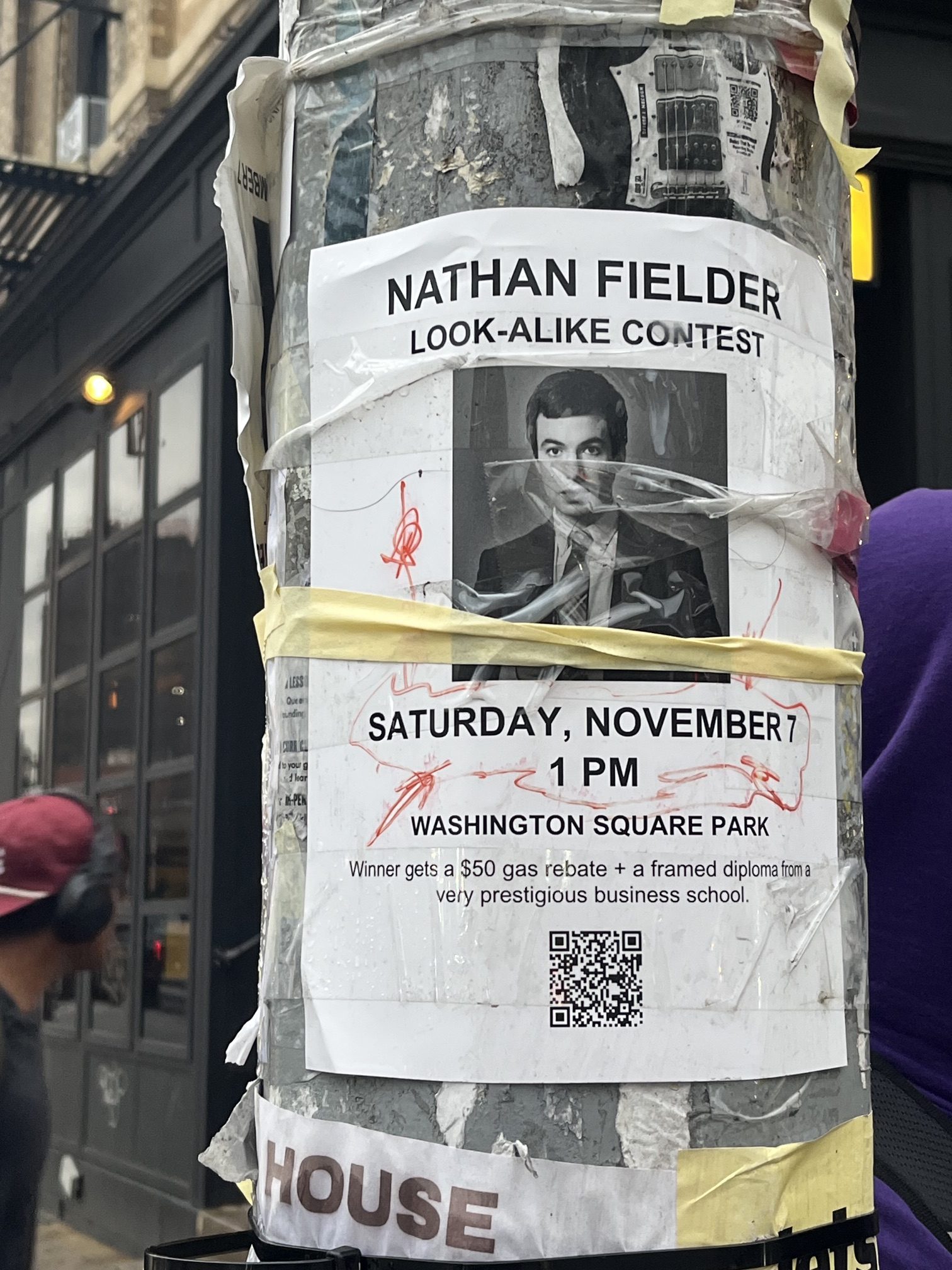
Flyer for Nathan Fielder look-alike contest (Photo: Donna Oblongata)
The circular discourse about You Can See Everything and our inability to look away from every new development in the Cornell case both demonstrate an almost nostalgic kind of grasping for a time when truth could be clearly heard, or at least understood to exist somewhere. But the men directing our attention—from Fielder to Bezos to Musk to Zuckerberg—seem completely disinterested in such a thing. Signal jamming is their very business model. I don’t personally know Amy Chozick, the journalist whose quoting of Holmes becomes a sort of fulcrum of the film, but her wonderful recent op-ed for The New York Times about her version of events makes me think that she would back me up on this—at least with regard to Fielder.
And what would it do for these men if we had gut-level truths being aired unobstructed, all signal, no noise? Where would their power go if we could actually tune in long enough to hear that ring? What would we be capable of if we could actually hold our feelings about the Cornell case and what we know about Holmes and about the larger world of titans she was moving within all at the same time? We might be able to stand with our heels square to the world and say, God forbid a girl lie a little to her investors.
Donna Oblongata is a multidisciplinary artist whose work has been called “Weird and wonderful” by The Art Newspaper and “Madcap absurdity that’s a joy to see” by The Scotsman. She has shown work at the Eugene O’Neill Theater Center, Ars Nova (NYC), SXSW, Miami Art Week, Edinburgh Fringe Festival, and shared the stage with Mikhail Baryshnikov in Slava’s Snow Show. She’s the recipient of a 2025 Leeway Transformation Award and a 2024 Creative Research Grant from the Foundation for Contemporary Arts. Donna’s work has been supported by MacDowell, the Ellis-Beauregard Foundation, Meow Wolf, and Dr. Bronner’s Soaps, among others. In 2024, her protest art in support of Gaza was acquired by the Jewish Museum in Washington DC. She lives in Philadelphia.